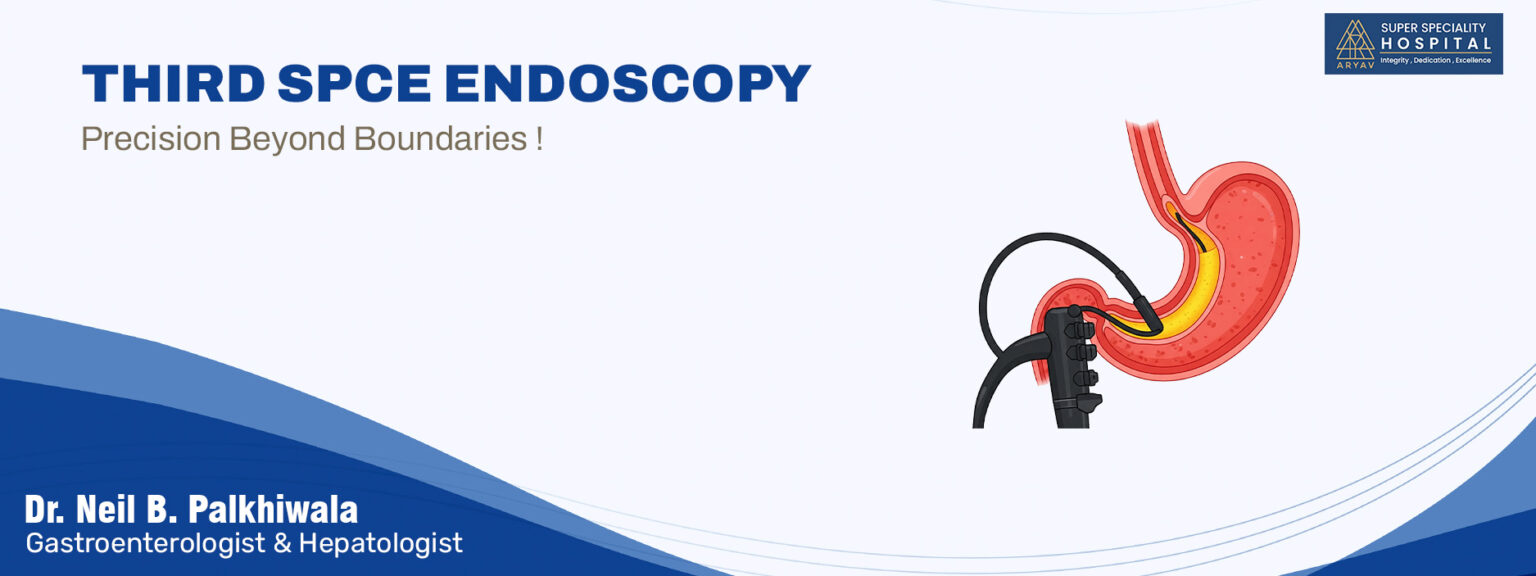
What is Third Space Endoscopy?
Third Space Endoscopy is an advanced, minimally invasive endoscopic technique used to treat certain gastrointestinal conditions by accessing the “third space” – the layer between the mucosa (inner lining) and the muscular layer of the GI tract.
What is Third Space?
- The first space: The inside of the digestive tract (lumen).
- The second space: The outer surface of the digestive tract (outside the organ).
- The third space: The potential space within the wall of the GI tract, between the mucosa and muscle layers.
How Third Space Endoscopy Works?
- A small incision is made in the mucosa to enter the third space.
- The endoscope is advanced between the mucosal and muscle layers.
- Treatment (such as cutting muscle fibers or removing lesions) is done safely within this space.
- The mucosal incision is closed after the procedure, promoting fast healing.
Types of Endoscopy Procedures - What is POEM, ESD and EMR?
1. POEM (Peroral Endoscopic Myotomy)
POEM is a minimally invasive endoscopic procedure used to treat achalasia - a condition where the esophagus muscles fail to relax, causing swallowing difficulties.
- The doctor uses an endoscope inserted through the mouth to cut the muscles at the lower end of the esophagus.
- This relieves the tightness and allows food to pass smoothly into the stomach.
- It’s an effective, scar-free alternative to surgical myotomy.
2. EMR (Endoscopic Mucosal Resection)
EMR is a technique to remove abnormal or precancerous tissue from the lining of the digestive tract, such as large polyps or early cancers.
- Fluid is injected under the lesion to lift it.
- A snare is used to cut and remove the tissue during endoscopy.
- It is less invasive than surgery and allows both treatment and diagnosis.
3. ESD (Endoscopic Submucosal Dissection)
ESD is an advanced form of EMR designed to remove larger or deeper lesions in one piece.
- The doctor carefully dissects the lesion from the submucosal layer using specialized instruments.
- ESD provides a more complete removal with lower recurrence risk.
- It requires more expertise and time than EMR but is highly effective for early cancers.
Important Third Space Endoscopy Procedures
Endoscopy procedures are of different types based on the part of the body being examined. Common ones include upper GI endoscopy (to view the esophagus, stomach, and duodenum), colonoscopy (to examine the colon and rectum), and capsule endoscopy (using a swallowable capsule to capture images of the small intestine). Other specialized types include bronchoscopy for the lungs, cystoscopy for the bladder, and laparoscopy for the abdominal cavity.
Complex Endoscopy Procedures
Complex endoscopy procedures are advanced techniques used not just for diagnosis but also for treatment of gastrointestinal conditions. These include Endoscopic Retrograde Cholangiopancreatography (ERCP) for bile and pancreatic ducts, Endoscopic Ultrasound (EUS) for detailed imaging and biopsies, and Therapeutic Endoscopy for procedures like polyp removal, stent placement, or controlling bleeding. They require highly skilled specialists and advanced hospital infrastructure.
Summary Table
| Procedure | Purpose | Key Benefit | Ideal For |
|---|---|---|---|
| POEM | Treat achalasia (esophageal issue) | Minimally invasive muscle cutting | Patients with swallowing difficulty |
| EMR | Remove precancerous lesions | Quick removal of small/medium lesions | Early-stage cancers & polyps |
| ESD | Remove larger/deeper lesions | Complete en bloc resection | Larger or complex early cancers |
The choice depends on the condition, location, and depth of the lesion.
Dr. Neil Palkhiwala - Third Space Endoscopy Specialist Doctor in Ahmedabad
Third space endoscopy has transformed the management of complex gastrointestinal motility and submucosal disorders. Since these procedures demand high technical proficiency and accurate diagnosis, specialist evaluation is crucial. Patients seeking advanced endoscopic care often rely on the best Gastroenterologist near me in Ahmedabad for precise diagnosis, expert execution, and comprehensive post-procedure care.
Schedule your Third Space Endoscopy with Dr. Neil Palkhiwala, Director and Head at Aryav Multispeciality Hospital, Ahmedabad. Call us to book your appointment or ask any questions at +91 91069 95254.