ERCP Procedure in Ahmedabad
ERCP is an advanced endoscopic procedure used to diagnose and treat bile duct and pancreatic duct problems, including bile duct stones, blockages, strictures and obstructive jaundice.
Quick Summary
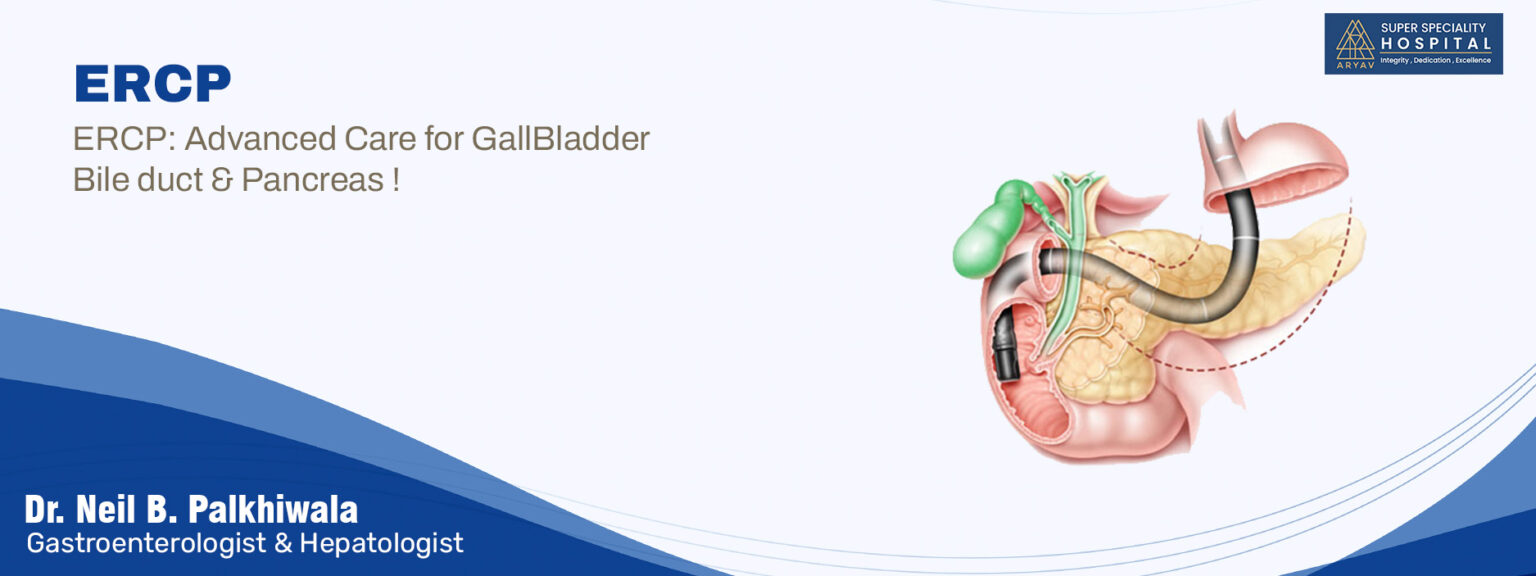
ERCP (Endoscopic Retrograde Cholangiopancreatography) is a specialized procedure that combines endoscopy and X ray imaging to diagnose and treat blockages, stones and other disorders of the bile ducts and pancreatic ducts. It can be used for bile duct stone removal, biliary stent placement and treatment of obstructive jaundice. Dr. Neil Palkhiwala provides advanced ERCP care at Aryav Super Speciality Hospital, Ahmedabad.
What Is ERCP and When Is It Recommended?
ERCP stands for Endoscopic Retrograde Cholangiopancreatography. It is one of the most advanced interventional procedures in modern gastroenterology. By combining high definition flexible endoscopy with real time fluoroscopy (X ray imaging) and radiographic contrast dye, ERCP allows a gastroenterologist to navigate the complex anatomical tree of the biliary and pancreatic ducts.
In contemporary clinical practice, diagnostic non-invasive tools such as MRCP (Magnetic Resonance Cholangiopancreatography) and Endoscopic Ultrasound (EUS) are frequently used for initial imaging. Consequently, an ERCP is primarily performed as a therapeutic procedure, where the doctor diagnoses a problem and performs targeted corrective treatment during the very same session.
Doctors recommend an ERCP procedure in Ahmedabad when patients present with specific clinical conditions, including:
- Choledocholithiasis (CBD Stones): Gallstones that have migrated from the gallbladder into the common bile duct, causing sharp abdominal pain, infection, or bile blockage. (Gallstone Treatment)
- Obstructive Jaundice: Yellow discoloration of the skin and eyes accompanied by dark urine and pale stools due to bile duct obstruction. (Jaundice Clinic)
- Acute Cholangitis: A severe bacterial infection of the biliary tract requiring urgent drainage to prevent sepsis.
- Gallstone-Induced Pancreatitis: Inflammation of the pancreas triggered by a stone temporarily or permanently blocking the ampulla. (Pancreatitis Management)
- Bile Duct Strictures: Benign or malignant narrowings that restrict normal hepatic drainage. (Bile Duct Disease Treatment)
- Post-Surgical Bile Leaks: Leaks following gallbladder surgery (cholecystectomy) requiring temporary stenting to facilitate duct healing.
Bile Duct and CBD Stone Removal Using ERCP
Gallstones form in the gallbladder, but smaller stones can travel through the cystic duct into the Common Bile Duct (CBD). When a stone lodges in the CBD, it halts the flow of bile from the liver into the intestine, leading to biliary colic, jaundice, and potential life-threatening infections.
CBD stone removal via ERCP provides a definitive, minimally invasive alternative to traditional open abdominal surgery. During therapeutic ERCP in Ahmedabad, the procedure proceeds through specialized interventional steps:
ERCP Sphincterotomy (Papillotomy)
A micro-electrocautery wire is used to make a controlled incision in the Sphincter of Oddi (the muscular valve opening at the ampulla of Vater). This enlarges the duct opening so stones can pass freely into the duodenum.
Balloon & Basket Stone Extraction
Dr. Neil guides specialized balloon catheters or Dormia wire baskets above the stone, inflates the balloon, and gently sweeps the stones down and out of the bile duct directly into the bowel.
For unusually large or impacted stones exceeding 15 millimeters, mechanical lithotripsy can be performed. The stone is engaged within a reinforced basket and crushed into smaller fragments that are then systematically cleared, restoring complete biliary flow.
Biliary Stent Placement and Obstructive Jaundice Management
Obstructive jaundice occurs when bilirubin cannot drain into the digestive tract, building up in the bloodstream and tissues. Immediate biliary decompression is vital to relieve itching, normalize liver enzyme levels, and eliminate the risk of hepatic failure.
Biliary stent placement is a primary therapeutic mechanism in ERCP. Stents are small hollow tubes inserted across narrowed, compressed, or blocked segments of the duct:
-
Plastic Biliary Stents: Flexible polymer stents used for temporary drainage in benign conditions, such as resolving post-cholecystectomy bile leaks, managing difficult unextracted stones before a second clearance session, or bridging benign inflammatory strictures. Plastic stents are typically removed or exchanged after a few months.
-
Self-Expanding Metal Stents (SEMS): Metallic mesh cylinders that provide wider diameter drainage and long term patency for biliary stent placement in Ahmedabad. SEMS are primarily indicated for malignant biliary obstruction, including cholangiocarcinoma (bile duct cancer), pancreatic head tumors, or extrinsic nodal compression, ensuring sustained quality of life and uninterrupted biliary drainage.
In emergency situations such as acute suppurative cholangitis, placing a biliary stent or performing urgent ERCP sphincterotomy in Ahmedabad relieves ductal pressure instantly, serving as an indispensable component of obstructive jaundice treatment in Ahmedabad.
How Is the ERCP Procedure Performed?
Undergoing an ERCP procedure in Ahmedabad involves organized, multidisciplinary preparation to maximize safety and precision:
Step-by-Step Procedure Workflow
- Pre-Procedure Preparation: Patients fast for at least 8 hours to ensure the stomach and duodenum are completely clear. Essential blood investigations, including Liver Function Tests (LFT) and coagulation profiles, are reviewed.
- Sedation & Monitoring: The procedure is performed under conscious sedation or monitored anesthesia care (MAC). You remain relaxed, comfortable, and asleep, with continuous vital signs monitoring by an anesthesiologist.
- Duodenoscope Navigation: Dr. Neil gently introduces a specialized side-viewing duodenoscope through the mouth, down the esophagus, and into the duodenum adjacent to the ampulla of Vater.
- Selective Cannulation & Contrast Injection: A thin catheter (sphincterotome) is slid through the scope into the bile or pancreatic duct opening. A small amount of contrast dye is injected, outlining the duct system under real time X ray fluoroscopy.
- Therapeutic Intervention: Real time imaging identifies the exact pathology. Dr. Neil immediately performs the necessary therapy: sphincterotomy, stone extraction via balloon/basket, stent deployment, or brush cytology for tissue analysis.
- Completion: The scope is gently withdrawn, and the patient is transferred to the recovery suite for observation.
Who Is the Best ERCP Doctor in Ahmedabad?
Performing high precision ERCP requires advanced technical expertise, deep anatomical knowledge, and dedicated interventional training. Dr. Neil Palkhiwala is recognized as a leading ERCP specialist and Consultant Gastroenterologist in Ahmedabad.

Dr. Neil B. Palkhiwala
MD (Medicine), DM (Gastroenterology), MRCP SCE (Gastroenterology & Hepatology, UK)
Consultant Gastroenterologist, Hepatologist & Advanced Interventional Endoscopist with 12+ years of clinical excellence, practicing at Aryav Superspeciality Hospital, Ahmedabad.
Dr. Neil routinely manages high-complexity biliary and pancreatic cases with clinical precision. Key highlights of his practice include:
- Comprehensive Hepatobiliary Care: Integrated clinical expertise as a leading ERCP gastroenterologist in Ahmedabad with dedicated focus on Gastroenterology and Hepatology for liver, gallbladder, and pancreatic disorders.
- Hospital Infrastructure: Based at Aryav Superspeciality Hospital, Science City Road, Sola, Ahmedabad, featuring a dedicated endoscopy suite, digital flat-panel fluoroscopy C-arms, and 24x7 intensive care backup.
- High Success Rate: Proven track record by an experienced ERCP specialist in Ahmedabad in selective duct cannulation, difficult CBD stone removal, and complex biliary stenting.
- Patient Trust: Over 439 verified 5.0 Google ratings from patients seeking the best ERCP doctor in Ahmedabad for safe, definitive gastrointestinal care.
ERCP Cost in Ahmedabad: What Determines the Price?
The cost of an ERCP (Endoscopic Retrograde Cholangiopancreatography) test in Ahmedabad ranges from ₹12,000 to ₹60,000, with an average cost of around ₹45,000. Because ERCP is tailored to each individual patient's anatomical condition and therapeutic requirements, key factors that determine the overall cost include:
- Doctor Expertise: The experience and skill level of your ERCP doctor in Ahmedabad performing high-precision interventional procedures.
- Nature of the Procedure: Pure diagnostic visualization versus therapeutic ERCP in Ahmedabad for stone clearance and duct dilation.
- CBD Stone Removal Complexity: Single small stone versus multiple, large, or impacted stones requiring Dormia baskets or mechanical lithotripsy for bile duct stone removal in Ahmedabad.
- Biliary Stent Placement: Standard polymer plastic stents versus specialized Self-Expanding Metal Stents (SEMS) for biliary stent placement in Ahmedabad.
- Anesthesia & Sedation: Type and duration of monitored anesthesia care administered by the anesthesiology team for total comfort.
- Hospital Infrastructure: High-definition endoscopy suites, digital flat-panel fluoroscopy, and day-care vs. inpatient room categories at Aryav Superspeciality Hospital.
- Insurance & Mediclaim Assistance: Comprehensive cashless insurance processing and TPA approvals available for patients.
During your clinical consultation, Dr. Neil provides a transparent, detailed breakdown of anticipated procedural requirements and estimated costs.
Recovery, Hospital Stay and Potential Risks of ERCP
Understanding what to expect after your ERCP ensures a smooth, well-managed recovery process:
Recovery & Observation
After completion, you will rest in the recovery bay for 1 to 3 hours while the sedative wears off. Most straightforward therapeutic ERCP procedures allow discharge on the same day or following a short overnight observation stay. Normal routine activities can usually be resumed within 24 to 48 hours.
Safety & Risk Management
ERCP is a safe procedure when performed by an experienced specialist. Minor potential risks include temporary post-ERCP pancreatitis (prevented via guidewire techniques and medication protocols), mild post-sphincterotomy bleeding, or infection, all of which are managed with strict clinical vigilance.
You may experience temporary throat soreness from the scope or slight abdominal bloating from the air used to visualize the digestive tract. These symptoms are mild and typically subside within 24 hours.
Frequently Asked Questions (FAQ) About ERCP in Ahmedabad
Consult with Dr. Neil Palkhiwala for ERCP in Ahmedabad
Get expert evaluation for bile duct stones, jaundice, or pancreatic disorders at Aryav Superspeciality Hospital.
Available Procedures

Need Expert Consultation?
Get personalized clinical evaluation and accurate treatment from Dr. Neil Palkhiwala, leading Gastroenterologist in Ahmedabad.
Book An Online Appointment